Category: AI efficiency

  • Automate last

    Automate last

    Automate last

    The tempting order is: pick a tool, then invent a use for it. That is how you end up with a chatbot nobody asked for and the same backlog on Monday.

    The useful order is the other way round.

    The sequence

    Question the requirement. Is this job real? Who needs the output? What happens if you do it less often?

    Delete. If it is not required, stop. Do not build a clever way to keep it.

    Simplify. One owner. One list. Fewer steps. Fewer fields. The version a new starter could follow without a walkthrough from the person who “just knows.”

    Speed it up. Same work, less waiting. Batch it. Answer it once. Cut the loop where three people touch a file to add one line.

    Automate last. Only when the steps are worth keeping, and are boring enough that a tool will not make them worse.

    If you skip to the end, you cement the junk. You also make it harder to delete later, because now it is “in the system.”

    What automation is for

    Automation is for the step you have already decided must happen, the same way, often enough that a person is wasted on it. Pulling last month’s figures into a one-page note. Turning a completed checklist into the email you always send. Drafting the first pass of a quote you will still read.

    It is not for judgement you are not willing to stand over. It is not for a process you have not watched. It is not a way to avoid talking to the people who do the work.

    How we use this in the room

    In an Accendo Intelligence session we do not start with a product list. We start with your week. We ask, we watch, we cut. A tool appears only if it is the last move, not the first.

    That is why the half-day workshop ends with a short, ordered list instead of a stack of logins. You should be able to see, in a month, whether the change saved time. If it did not, we drop it. No loyalty to a subscription.

    If you have already been sold the tool, come anyway. The useful question is still the same: what should we have deleted before we automated it?
    Book

  • Less paper, fewer tools, less cost

    Less paper, fewer tools, less cost

    Less paper, fewer tools, less cost

    A lot of “AI” sold to small firms is a new place to put the same mess. Another login. Another export. Another person who has to feed the system so it looks used.

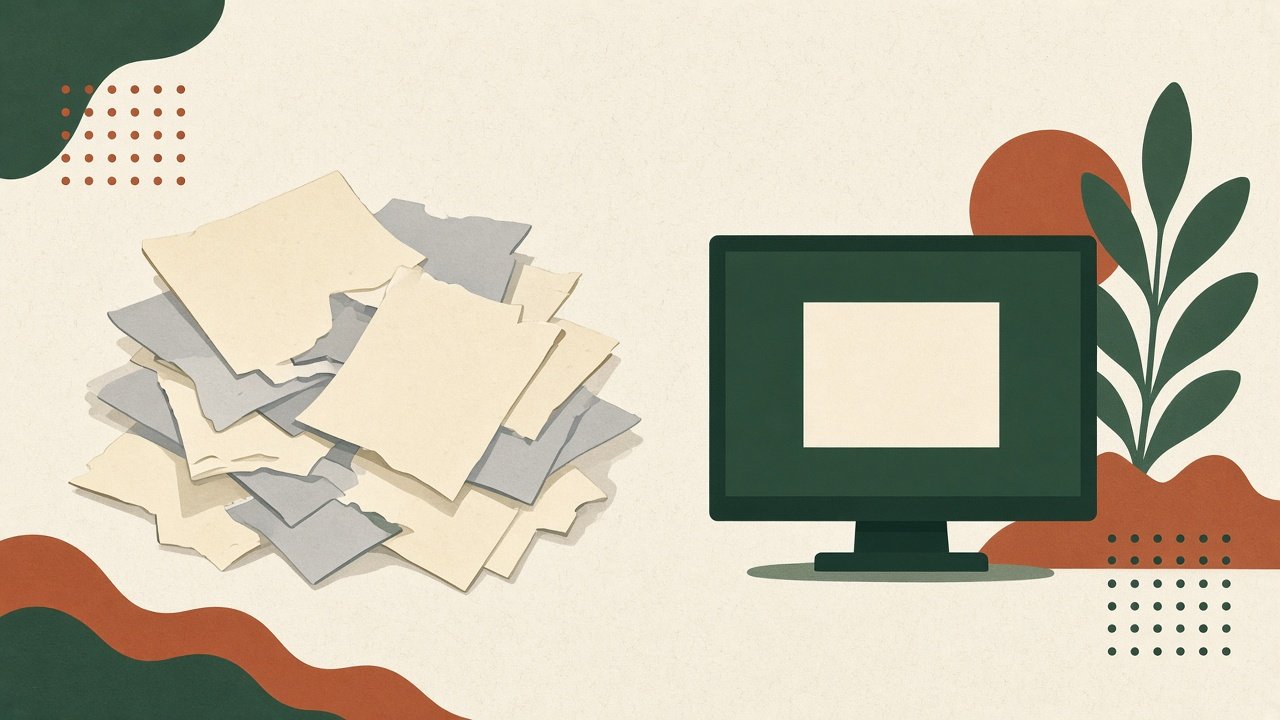
    The useful version is duller, and better. Put the work on a screen instead of a pile. Stop copying it. Make the useful version cheap enough that you will still use it in a busy month.

    Put it on a screen (and leave it there)

    Paper is not evil. It is slow when it is the only copy, and it is dangerous when it is the third copy. If the quote, the checklist, or the site note already lives in email, do not print it so you can scan it back in.

    The test is simple. Can the person who needs it find the current version without asking you? If not, you do not have a document. You have a hunt.

    Digitising is not a portal with twenty modules. It is one shared place for the thing you already do, that the people who do the work can open on a phone.

    Stop making the same thing twice

    Do not recreate the same artefact. The PDF that is also a spreadsheet that is also a WhatsApp photo. The policy that exists so you can attach it, not so anyone follows it.

    If two files must stay in sync by hand, one of them should go. If a tool only works when someone retypes yesterday’s jobs into it, that is not efficiency. That is a second job.

    Make it cheap enough to keep

    The last part is money and fuss. A tool that needs a specialist, a long contract, or a weekly ritual you will skip in week three is not a saving. The right tool for an SME is the one you still open when a job overruns.

    We would rather you use a boring, cheap thing well than a clever platform you resent. If a free or low-cost option does the job, that is a feature. Democratising the useful bit (so a five-person firm can have what a fifty-person firm paid a consultant to build) is the point, not a slogan.

    None of this needs a transformation budget. It needs an honest look at one process: can it live in one place, once, at a price you will not notice?

    That is the pass we do in the workshop. No software sale. If the answer is “keep the notebook,” we will say that.

    Book

  • Ask first. Then look at the work.

    Ask first. Then look at the work.

    Ask first. Then look at the work.

    The usual AI session starts with a demo. A tool, a case study, a promise that “firms like yours” save hours. Then you go back to your inbox and nothing has changed, because nobody asked how your week actually runs.

    We flip it. Ask first. Walk through the real work. Only then sit down and decide what is worth doing.

    Why the questions come first

    Owners already know the pain. “Quotes take too long.” “We rewrite the same email.” “The office is buried in attachments.” What they often have not named is the cause. Is it a missing template, a person who holds the lot in their head, a client who wants a new format every time, or a tool you already pay for and ignore?

    If you start with software, you guess. If you start with questions, you find out which of those it is. Sometimes the answer is not a tool at all. Sometimes it is one conversation, or deleting a report nobody reads.

    Then run through the work, not a slide

    Bring the actual stuff. Last week’s quotes. The inbox. The spreadsheet that “only Sharon understands.” Sit with the people who do it, not a separate AI lead who will have to translate later.

    You watch where time goes. You see the rework. You see the print-sign-scan loop that could have been a form. You see the job that is painful because it is unclear, not because it is hard.

    That is the session. It is ordinary, and it is more useful than a generic talk.

    The workshop sits at the end, not the start

    Only after that do we pick anything. A short list: what to try, what to ignore, who owns it. One or two tools you will use this month. A simple way to check, in four weeks, whether it saved time.

    That is the Accendo Intelligence habit in one line: ask, look at the work, then decide. The half-day workshop is built that way on purpose. You do not need a tech background in the room. Sceptical is fine. We would rather you argue with a suggestion than nod and never use it.

    If you want the short version before a half day, the 30-minute call is for that. If you already know the process and want it walked, the 90-minute review is the middle step.

    Book

  • You do not need an AI strategy

    You do not need an AI strategy

    You do not need an AI strategy

    Most small firms do not have an AI problem. They have a week that disappears into email, rework, chasing, and copying the same facts into three places.

    Someone then says you need a strategy. A roadmap. A steering group. That is a good way to spend six months and still be copying invoices on a Friday.

    You need a shorter question: what are we actually required to do, and what can we stop?

    Start with the requirement, not the tool

    Before you buy anything, write down the job in one sentence. “We need a weekly report for the client.” “We need to quote faster.” “We need fewer missed follow-ups.”

    Then ask whether that job is real. Who asked for it? What happens if you do it less often, or not at all? A surprising amount of “must” is habit, a leftover from a bigger firm, or a template nobody reads.

    If the job is not required, delete it. Do not automate a thing you should have stopped.

    Make what is left simpler

    If the job stays, strip it. One list, not three. One place the number lives. One person who owns it. Fewer fields on the form. A shorter email.

    Speed comes after that. Same steps, less waiting: batch the quotes, answer the same three questions with a saved note, stop bouncing a file around the team.

    Only then look at a tool. Automation last. If you automate a mess, you get a faster mess, and you pay a subscription for the privilege.

    What this looks like in a small firm

    You do not need a transformation programme. You need one slice of work, the people who actually do it, and an honest pass:

    1. What is required?

    2. What can we drop?

    3. What can we simplify?

    4. What can we do sooner?

    5. What, if anything, should a tool take?

    That is the whole method. It is how we run the AI Efficiency Workshop. Questions first, the real work on the table, a short list at the end. Not a slide pack about the future of work.

    If someone is still selling you a 40-page AI strategy, ask them which Friday afternoon task it will remove this month.

    Book a call or the workshop