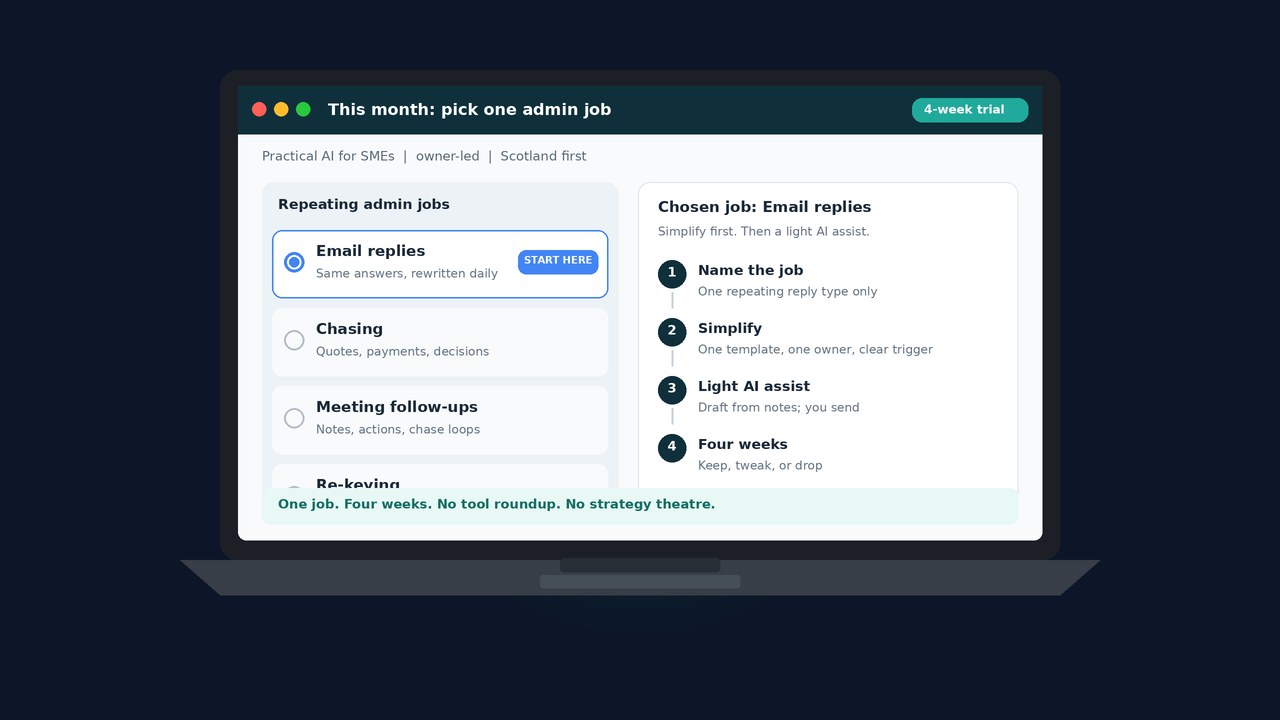
Practical AI for SMEs does not start with a tool shortlist. It starts with one repeating admin job you will actually change this month. Email replies, chasing, meeting follow-ups, or re-keying. Pick one. Simplify it. Then try a light AI assist for four weeks.
Owner-led firms in Scotland (and across the UK) stall after they map the week. The map shows the noise. The hard part is choosing where to start.
Why do owners stall after mapping the week?
Because the map makes everything look urgent. Inbox. Chases. Notes. Copying the same fact into three places. Buying five tools at once feels productive. It rarely is.
You do not need an AI programme. You need one named job with a clear owner and a date you will check whether it got easier.
Which admin job should you pick first?
Choose work that repeats every week, that you already understand, and that one person can own. Prefer a job where a draft, a summary, or a cleaner first pass would help, and where a human still decides what goes out.
Four common candidates:
Email replies. Same three answers, rewritten from scratch. Good first pick if your week vanishes into the inbox.
Chasing. Quotes, payments, or decisions that sit until Friday. Good if follow-up has no owner and no next step.
Meeting follow-ups. Notes written, rewritten, then chased. Good if calls create more admin than decisions.
Re-keying. Numbers and facts pasted between tools. Good if the same detail lives in a spreadsheet, a quote, and a message.
If two look equal, pick the one that happens most often and that you can simplify without a new system. Drop anything that exists only because “we have always done it.”
How do you simplify before you add AI?
Name the job in one line. Who triggers it. Who finishes it. What “done” looks like.
Then strip noise:
- One template instead of a blank page every time
- One place the fact lives
- One person who owns the chase
- One trigger (a call ends, a quote goes out, a payment is late)
Do not automate a mess. AI for admin pays when the work is already clear enough that a draft can help. If the process is muddy, fix the mud first.
What does a light AI assist look like for four weeks?
Keep the tool thin. You are not rebuilding the business.
Examples that stay light:
- Draft a reply from three bullet notes, then you edit and send
- Turn a rough call note into actions and a short follow-up
- Suggest the next chase message from the last email thread
- Pull key facts from one source so you stop retyping them
Rules for the trial:
- One job only for four weeks
- Same person uses it every week
- You still approve anything client-facing
- At the end of week four, decide: keep, tweak, or drop
If you cannot say what you will stop doing when it works, you are not ready to buy seats. You are still guessing.
How will you know it worked?
Keep a short note, not a dashboard. For the chosen job, jot time spent and friction before the trial, then again after four weeks. Ask:
- Did drafts get out faster without more mistakes?
- Did chasing need fewer reminders?
- Did re-keying shrink, or just move?
- Would you keep paying for this next month?
That is enough. Practical AI for small business Scotland (and UK-wide) is measured in a clearer week, not in a strategy slide.
What if you want help choosing the first job?
If you would rather not do this alone, Accendo Intelligence runs a half-day AI Efficiency Workshop for owner-led firms. From £625 for a small room (typically 3 to 5 people). We map where the week goes, pick the first admin jobs worth a light assist, and leave you with a short ordered list. Scotland first, UK-wide remote. No tool roundup. No strategy theatre.
Pick one job this month. Simplify it. Trial a light assist for four weeks. That is how AI for admin earns its place.
Leave a Reply